What Searches Are Done When Buying a House?
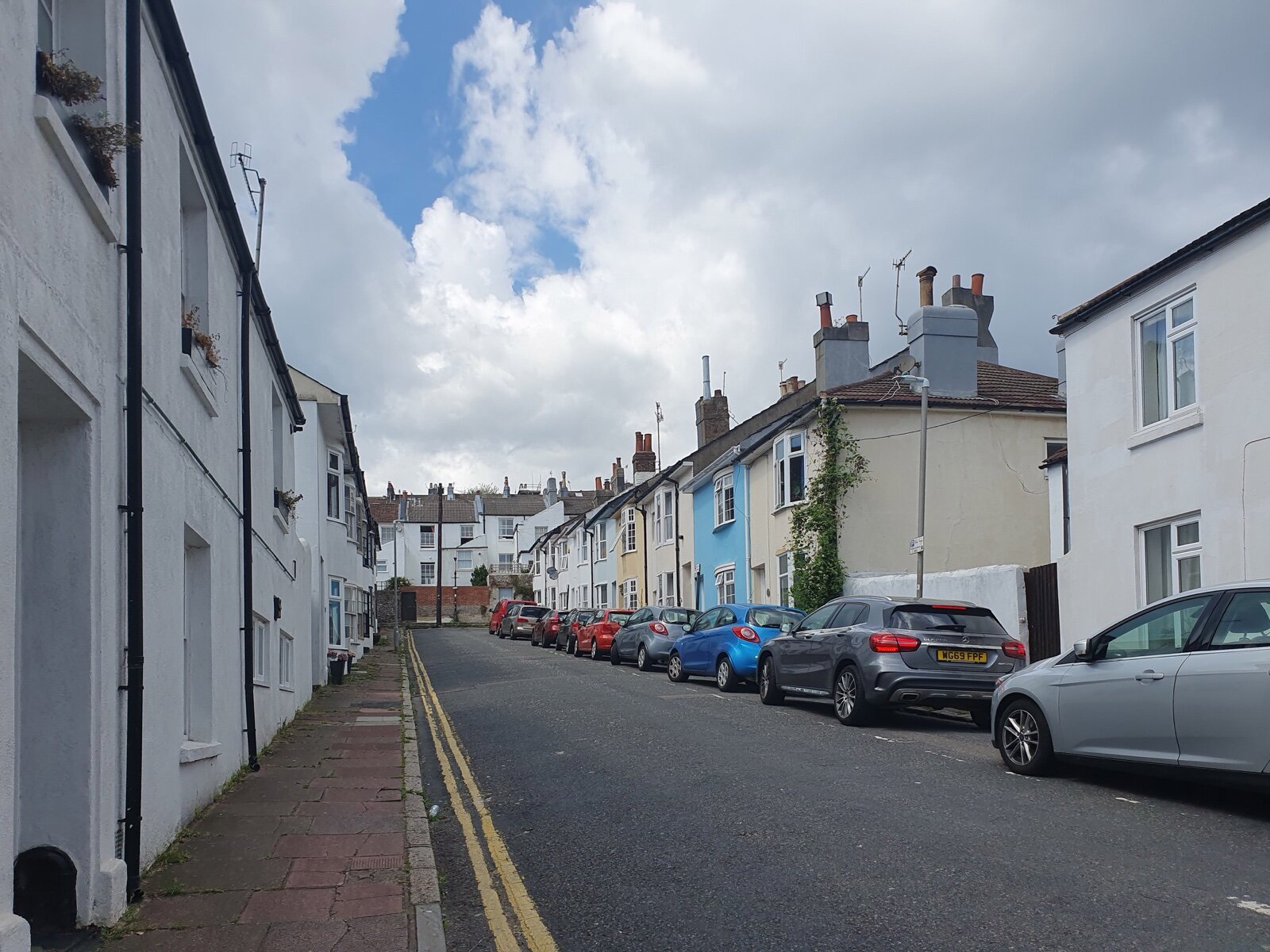
Railway Street, Brighton, East Sussex - July 2025 by Mutney (CC BY 4.0), via Wikimedia Commons

You will see a line on your quote for searches, usually a few hundred pounds, and almost nobody explains what you are buying. Here are conveyancing searches explained in plain terms: what searches are done when buying a house in Sussex, who orders them, what each one is actually looking for, what none of them will tell you, and how long the slowest one is likely to hold up your exchange.
What a search is, and what it is not
A search is a request for information about the land, put to a body that holds records about it. Your conveyancer sends the enquiry, receives a written result and reports it to you and to your lender. Every search is about the legal and physical position of the plot and the area immediately around it. None of them is a survey. A search will not tell you the roof is failing, the boiler is 22 years old or the extension is badly built. That is what a RICS level 2 or level 3 survey is for, and it is a separate instruction you make yourself.
The other thing to hold on to: searches are property specific and boundary specific. A local authority search reveals what the council holds against your address, not what is planned three streets away. If you want to know about a proposed development nearby, you look at the council's planning register yourself.
The three searches almost every buyer pays for
1. The local authority search: LLC1 plus CON29
This is really two documents ordered together, and it is the one most likely to be the bottleneck.
The LLC1 is an official search of the local land charges register. It lists charges that bind the property whoever owns it: conditional planning permissions, listed building status, conservation area designation, tree preservation orders, smoke control orders, enforcement notices, and financial charges where the council has spent money on the land and expects it back. HM Land Registry has been taking these registers over from councils under the Infrastructure Act 2015 and running them as one national digital register. Where a council has migrated, you can pull a personal search from the national local land charges register free of charge, or buy the official search for a fixed 15 pounds. Where it has not, the council still holds the register and sets its own fee, which is why the same search costs very different amounts in different Sussex districts.
The CON29 is the set of required enquiries of the local authority, on a standard form maintained by the Law Society. It covers the practical questions the register does not: whether the road serving the property is publicly maintained, what planning and building control history exists at the address, whether there are road schemes, traffic orders or railway proposals nearby, and whether the council has served notices. A shorter CON29O of optional enquiries covers extras such as public paths, common land and rights of way, ordered when the property makes them relevant.
Two CON29 answers cause more late panic in Sussex than any other. The first is an unadopted road: if the answer says the highway is not maintained at public expense, you are looking at a private road with shared repair liability. The second is building control. If a previous owner put in a loft conversion, took out a wall or replaced windows without a completion certificate or FENSA registration, this is where it shows up, and the seller will need to produce paperwork or an indemnity policy before your lender is happy.
2. The drainage and water search: CON29DW
Ordered from the water and sewerage company, which across Sussex is Southern Water, or from an authorised search provider using its data. The standard residential CON29DW answers a fixed set of enquiries and comes with plans of the public water mains and sewers. It confirms whether the property is connected to public foul and surface water drainage, whether it is connected to the mains, where the water meter is, how the property is billed, whether a public sewer runs within the boundary, and whether the property has a recorded history of internal sewer flooding or low water pressure.
A public sewer running under the garden matters more than it sounds. It restricts what you can build over it and it means the water company has a right of access. Older Sussex terraces and postwar estates both throw this up regularly.
3. The environmental search
Not a Law Society form but a commercial report, ordered as standard by most firms and required by many lenders. It screens the address against contaminated land records, past industrial and landfill uses, flood risk, ground stability and radon. On the Weald clay that runs through the middle of both counties, shrink and swell subsidence is the entry to read carefully, and it feeds straight into what your buildings insurance will cost. Flood entries matter on the river valleys and the coastal strip, and the sensible follow up is to check the address yourself on the Environment Agency service for long term flood risk, which is free.
An environmental search is a desktop screen against datasets, not an inspection. A "passed" result means nothing on the databases triggered a concern at that address. It is not a warranty that the ground is clean.
The Land Registry work that runs alongside
These are not searches you choose, they are the mechanics of registering the purchase, and they appear on the disbursements list.
- Official copies of the register and title plan (form OC1). The starting point for the whole file. 7 pounds each through the HM Land Registry portal, 11 pounds by post, under the Land Registration Fee Order 2024.
- Official search with priority (form OS1). Done just before exchange or completion. It freezes the register for a priority period so nobody can slip an entry in ahead of your registration. Also 7 pounds by portal, 11 pounds by post.
- Search of the index map (form SIM). 8 pounds where five or fewer titles are disclosed. Used where the land is or may be unregistered, which still happens on older Sussex properties that have not changed hands in decades.
- Bankruptcy and land charges searches. Run against the names of the buyers, because your lender needs to know it is not lending to someone subject to insolvency proceedings.
Searches that depend on where the house is
Coal mining searches dominate the national advice and are irrelevant in Sussex. What is relevant here is a different set:
- Chancel repair liability. An ancient liability to contribute to the repair of a parish church chancel. Since October 2013 it only binds a buyer if it is protected by an entry on the register, but firms still screen for it and offer cheap indemnity insurance, because Sussex has a lot of medieval parishes.
- Flood search. An upgrade on the flood section of the environmental report, worth ordering on the Ouse, Adur, Arun and Cuckmere valleys and anywhere behind the shingle on the coast.
- Highways search. A separate enquiry to the county council where the CON29 answer on adopted highway is unclear, or where the property is set back from the road behind a strip nobody owns up to.
- Utility and mining variants. Rare here, but Sussex has old brickworks, gypsum workings near Mountfield and a scatter of former landfill sites that an environmental report will flag for a follow up.
Who orders them, when, and how long they take
Your conveyancer orders the searches, you pay for them, and they are almost always paid on account at the start rather than at completion. That is deliberate: search fees are non-refundable, so nobody wants to be out of pocket if the sale falls through.
The single best thing you can do for your timescale is to instruct and pay for searches as soon as your offer is accepted, rather than waiting for the survey or the mortgage offer. The drainage and water search and the environmental report usually come back within a few working days. The local authority search is the variable one: some councils turn it round in days and others take weeks, depending on whether their land charges register has been digitised and how the planning and building control side of the CON29 is resourced. It sits on the critical path, and a slow one is a common reason a chain misses a target exchange date.
Results are usually accepted by lenders for six months. If your transaction drags past that, expect to be asked to refresh them, or to buy search validation insurance instead.
Can you skip searches?
If you are buying with a mortgage, no. The lender's instructions require them, and no conveyancer on a lender panel will complete without them.
A cash buyer can technically decline, and some auction buyers do because the timetable does not allow it. It is a bad trade for anything you intend to live in. The cost of the full set is small next to the cost of discovering an enforcement notice, an unadopted road with a bill attached, or a loft conversion with no building regulations sign off. If a search cannot be obtained in time, the middle ground is search indemnity insurance, which most lenders accept: it covers the financial loss if something a search would have found later bites you. Note what it does not do. It does not tell you the information, it only pays out, and it will not respond if you had knowledge of the problem before you bought the policy. Never contact the council about a suspected issue before the policy is in place, because doing so usually voids it.
Reading the results
You will get a report on title from your conveyancer summarising all of it. Read the exceptions and the recommendations rather than the summary line. The entries worth stopping on are: any enforcement or breach of condition notice, any building control record with no completion certificate, an unadopted highway, a public sewer inside the boundary, a tree preservation order if you had plans for the garden, listed building or conservation area status if you had plans for the windows, and any environmental result that is not a clean pass. Each of those is either a price conversation with the seller, an indemnity policy, or a reason to walk.
Frequently asked questions
How much do conveyancing searches cost?
Expect the whole search pack to be one of the larger disbursement lines on your quote, driven mostly by the local authority search, whose fee is set by each council and varies widely across Sussex. Where HM Land Registry now holds the local land charges register, the official LLC1 is a fixed 15 pounds and a personal search is free. Land Registry official copies and the priority search are 7 pounds each through the portal and 11 pounds by post. Ask your conveyancer for the search fees itemised separately from their own fee.
How long do conveyancing searches take?
The drainage and water search and the environmental report usually return within a few working days. The local authority search is the unpredictable one and can take anywhere from a few days to several weeks depending on the council, because it depends on whether the land charges register is digitised and how quickly planning and building control answer the CON29. Order everything the week your offer is accepted, not after the survey.
Do searches show planning applications on neighbouring land?
Generally no. A CON29 answers questions about your property and, for some enquiries, about the roads immediately serving it. It is not a survey of the neighbourhood, so a proposed housing estate on the field behind will not normally appear. If that matters to you, search the district council's own planning register by postcode and look at the local plan for site allocations before you exchange.
What is the difference between a personal search and an official search?
An official search is produced by the body that holds the record and carries its liability. A personal search is compiled by a private search company inspecting the same records. Personal searches are cheaper and often faster and are backed by insurance, but not every lender accepts them, so check your lender's requirement before choosing on price alone.
Are searches still valid if my purchase is delayed?
Most lenders treat search results as valid for six months from the date they were issued. If exchange slips beyond that, you will be asked either to re-order the searches, which means paying again and waiting again, or to take out search validation insurance, which most lenders accept as an alternative. The Land Registry priority search is different and much shorter lived, which is why it is done immediately before completion.
Do I need searches if I am buying with cash?
There is no legal obligation, because the requirement comes from lenders. It is still the wrong corner to cut on a home you plan to live in: the pack costs a few hundred pounds against liabilities that can run into thousands, from an unadopted road to unauthorised building work. If the timetable genuinely does not allow it, as at auction, ask your conveyancer about search indemnity insurance before you commit.
Where searches sit in the wider move
Searches are one line on a much longer bill and one step in a longer timetable. The cost of moving house in Sussex page puts the disbursements alongside removals, stamp duty and the rest, and the solicitor vs licensed conveyancer comparison covers who you should be instructing to order them. For everything else about the move, start at the Move Sussex homepage.